

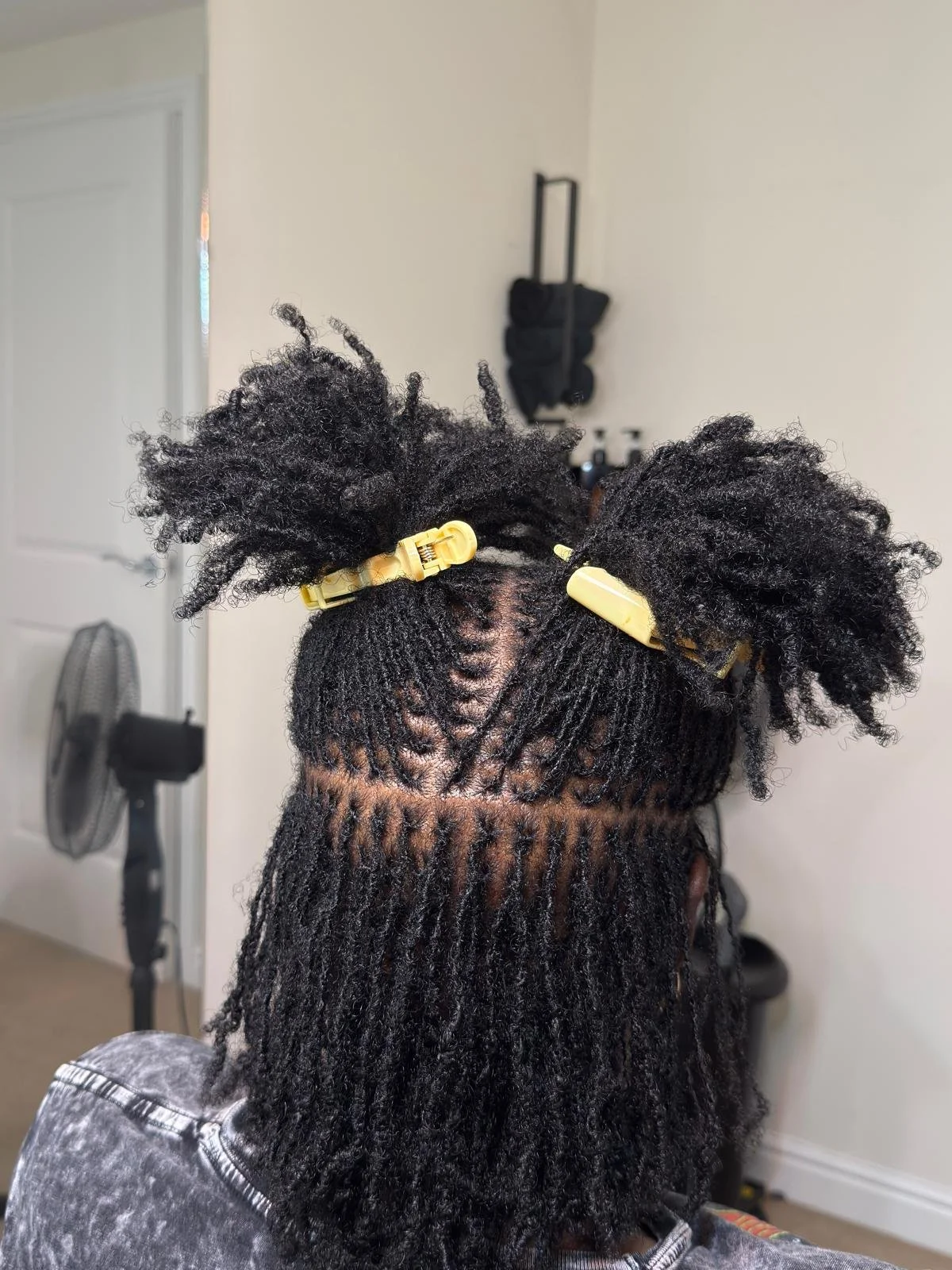
I've been having this client-inspired thought lately.
One of our repeat clients told me that sometimes they sit in the chair and pretend to understand the loc jargon we use when explaining how to care for their hair, but they really don’t, and that’s why they keep having the same loc issues.
That got me thinking of how much we locticians naturally like talking about and showing our technically impressive work. The cleanest grid. Tiny partings. Difficult color correction. Twelve-hour installations and all other glamorous behind-the-chair work.
And before you come for me, I want you to know that sharing all that is great and very understandable. We only notice the above things because we know how much time we put into them.
Our clients, on the other hand, DON’T.
They often look at the same hair but with different questions in their minds. Often, they are asking much simpler questions:
Can I actually live with this hair?
Can I get ready for work without fighting with it?
How often will I need to come back for maintenance?
Can I afford the upkeep?
Will it still suit me when the excitement of new hair wears off?
And in those questions lies the gap between selling techniques and selling services.
Let’s break that down further…
As stylists, we sell from the chair.
But clients don't buy from our view. They don’t buy our expertise. They buy for the life they return to after they leave our chair.
What matters to them is what our skills do for them and how they feel at the end of their appointment with us.
We often sell what was difficult to do
Technique took us time to learn. It separates trained work from guesswork. And after spending years improving our craft, we naturally want people to see it, so we talk about it when advertising our services.
And there is nothing wrong with that.
The problem begins when the technique becomes the whole sale.
Imagine someone considering microlocs. You tell them:
“We use a four-point rotation to interlock your hair.”
Now that sounds fancy and may be important to know. But unless the client already understands loc maintenance lingo, which is rarely the case, especially for new clients who still don’t know if microlocs suit them, let alone the method you use to interloc.
But if you say:
“We secure your roots between appointments and allow you to keep a regular maintenance schedule.”
Same sale. Different wording. Huge difference.
And just like that, the client now understands what you do and why it matters.
Technical language tells them what we’re good at. Useful language tells them what the service will do for them.
It is more about understanding what the customer is trying to accomplish, and less about assuming they are buying the service itself.
A client rarely wakes up wanting a four-point rotation. They wake up with a particular result in mind.
Sometimes that result is visual. “I want fuller-looking locs.”
Sometimes it is practical. “I do not want to spend an hour doing my hair every morning.”
Sometimes it is emotional. “I want to feel like myself again.”
Sometimes it is simply relief. “I need something I can actually manage.”
That is what you should be selling.
The technique, on the other hand, is how you deliver it.
This matters even more with long-term services such as starting locs.
Outside the installation day, a client also cares about future washing, maintenance appointments, styling options, cost, and how that hair will fit into everyday life.
Remember: A technically impressive service can still be the wrong service.
Someone may love microlocs but dislike the long maintenance appointments.
Someone may love a polished style, but they exercise and wash their hair often.
A client may ask for something they have seen online without understanding the care it needs afterward.
Good service is not simply saying:
“Yes, I can do that.”
Sometimes it is saying:
“Yes, I can do it. But from what you have told me about your routine, I think another option may suit you better.”
Help the client choose; stop them from just admiring
Your photos should show your skill, and your words help the client make a decision.
Instead of only saying:
“Microloc installation available.”
Also explain who might benefit from microloc-ing and what living with microlocs may look like.
This keeps the technical information and also translates it.
If your potential client can't read your service description and place themselves inside it, they won't understand it. And that means they won’t book you either.
They should understand who the service is for, what it asks of them, and how it fits their routine.
Sell day 30, not just day one
Most loc photographs we share capture only day one, yet we want our clients to imagine day 30.
What will the hair need by then?
How often will they need maintenance?
What will they need to do at home?
How will washing work?
Will the style they choose still make sense at work, with children, during exercise, or while traveling?
These questions may not sound as impressive as a four-point rotation, but they make the service real.
They also make loc consultations much more useful.
Back to my client at the beginning of this article:
These days, instead of spending the whole conversation explaining salon terms, we talk about the client's hair, routine, expectations, and what they actually want.
That conversation sometimes leads us away from the service they originally asked for. [And that is okay].
The goal is not to push everyone towards your most impressive work. It is to help the right client choose the right service.
And when they choose the right service:
The client leaves with more than good hair.
They understand what they chose.
They know what living with it will involve.
They are less likely to discover, three weeks later, that the service they loved in the photograph does not work in their real life.
They are more likely to return to your chair.
Something to change today
Pick one service you currently sell.
Open the description on your website, booking page, or social media.
Now ask:
“What does choosing this service make easier, better, or more manageable in my client's real life?”
Answer that well, and you make it easier for them to choose the service that suits them.
And much easier for them to choose you.
If you like our TressesbyK Loc business edition like this one, make sure you subscribe to our weekly newsletter, where we share experiences and lessons behind the chair.
