

Could Your Retie Schedule Be Hindering Your Locs’ Growth?
Why Timing Matters for Healthy Loc Growth
There’s a popular saying in the loc community: “The more overgrown, the better.” And yes—fluffy, bushy roots can look full, carefree, and sometimes admirable.
At TressesbyK, we believe that: stretching your retie schedule too far can quietly harm your locs. The tension caused by overgrowth can, over time, lead to alopecia, scarring, and slow your locs' growth.
On the other hand, rushing back onto our chair every couple of weeks isn’t the answer either.
Frequent reties can equally slow your growth and stress your scalp.
So, how do you find balance?
In this article, we explain how sticking to the correct timing schedule allows your locs to breathe and grow healthily.
The Ideal Retie Schedule by Loc Type
Let’s get it out of the way...
There’s no one-size-fits-all rule.
Most locticians recommend every 5–8 weeks. At TressesbyK, we recommend 4-8 weeks, depending on your loc type, lifestyle, and the maturity of your locs.
We will see more about what affects your loc retie schedule as you read along.
Meanwhile, take a peek at our expertise-tailored chart for our clients based on their loc needs.
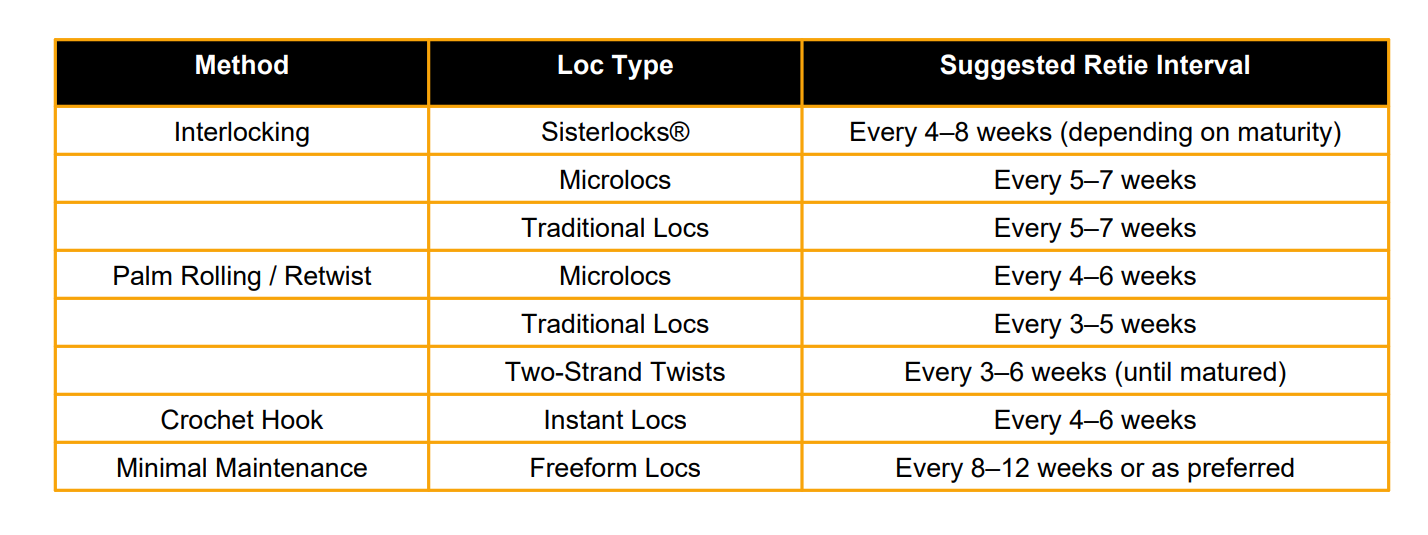
TressesbyK retie schedule chart
Pro tip: Stick to one loctician. Consistency in technique keeps your parts neat and your locs healthier in the long term.
Effects of Long Retie Periods
Stretching too far between reties may feel freeing, but it comes with risks:
Roots begin to mat together. Overgrowth causes sections to “marry,” making reties more forceful and stressful on your scalp and strands.
Tension builds unevenly. Strands pull from odd angles, [more like overgrowth from different strands], weakening follicles over time.
Edges suffer first. Your hairline and temples are the most fragile and prone to thinning.
Scalp health declines. When your hair overgrows, you risk having a lot of buildup, which will cause more irritation. The constant scratching from itching will then cause tiny wounds, leading to scarring, which affects your hair growth over time. Irritation can also be caused by the tough retied following a long overgrowth.
It costs more later. Reflect on that day you had overgrown locs. I bet you sat longer on your loctician’s chair, yes?
Overgrown locs not only cost you your time, but also go deeper into your pockets. Due to the care needed for overstayed locs, your loctician may charge more to make your parts neater again.
TressesbyK Simple fixes:
Book before the 6–8 week mark (depending on your loc type).
Keep daily tension low (avoid tight ponytails).
Watch for redness or soreness—your scalp is telling you to act sooner.
Effects of Frequent Reties
From the salon, the look is cute.
Having always tucked and neat locs makes you look responsible, unlike the shaggy locs type we discussed above.
But here is how it affects your locs:
Too much tension, too soon. If you retie every 2–3 weeks, your scalp never gets a break. It stays irritated and inflamed. Scaring is also highly possible, depending on the tension applied to your head with each retie.
Stunted/ slow growth. The constant manipulation changes the focus of your locs. Instead of growing, they spend energy healing from inflammation, irritation, and scarring.
Thinning edges and tenderness. The edges are often the first to be affected by various hair tensions. Too many reties, especially followed by constant styling, will make your edges fall off faster. Read about managing hair loss here.
Simple fix: Stick to your specific retie window. If it feels too tight, say something. A healthy retie should feel snug, not painful.
Factors That Influence Your Retie Schedule
Not all loc journeys are the same. Various factors affect how often you’ll need maintenance, below are some:
Wash Routine: This goes without saying; washing your locs frequently will unravel them faster, leaving you looking for a retie session sooner than you normally would.
But washing doesn't only unravel your locs from the constant rubbing and scrubbing. During a wash, your hair absorbs water, and the extra weight causes strands to loosen.
The pressure from water also displaces strands from their neat tuck.
Lifestyle: Let's say you are an active person. Constantly in the Gym, running, or participating in recreational or sports activities that cause excessive sweating in any way, your locs are likely to unravel faster, meaning you’ll need a retie sooner.
We have even had clients who are swimmers. Often, we tell them to try and protect their hair as much as possible. But if they can’t use swim caps for any reason, such as allergies to the material, we advise using light oil-based barriers. These prevent the hair from absorbing moisture. This also prevents the chlorine and other harmful pool chemicals from seeping into your locs.
Loc Size and type: If we go by tension, smaller locs have a lesser pull on your scalp, so less less hair strands are likely to fall off the loc grid. This makes people who have sister and micro locs need a longer retie as their locs stay neat for long periods post retie.
Larger locs, on the other hand, like the traditional locs, have a higher tension on the parts, therefore tend to ruffle faster.
Night Care: When we sleep, we make involuntary movements. One specific movement is us constantly rubbing our heads on the pillow. This causes friction and pulls hair from its neat loc pack.
Things like satin bonnets and pillow cases help reduce the friction, thereby causing a smooth glide that still maintains hair in its neat tuck.
In short, this is your call to start using satin bonnets if you are still sleeping with your locs uncovered.
Retie method: Crochet and interlocking stick longer than the old palm rolling. The first two methods at the beginning of this explanation involve tools to create bonds between hair strands. Hair strands are tied together, hence they stay longer.
For palm rolling, we hold the hair in place with wax, gel, or residue-free light oils, which means that with time, the products melt or wash away, and the hair uncoils easily.
Products Used: Heavy creams and products either lead to buildup, lint formation, or general slow growth if pores are blocked. If lint or buildup results, often the first instinct is to wash, and that takes us back to the first point in this section.
Are Your Reties Too Tight or Too Loose?
Too Tight: Pain, redness, bumps, headaches.
Fix: Speak up immediately. Request gentler tension. Use soothing scalp sprays.
Too Loose: Puffy roots, unraveling within weeks.
Fix: Book a touch-up. Switch to interlocking if palm rolling slips too fast.
Rule of thumb: You should leave the chair with your scalp feeling secure, not sore.
TressesbyK’s Recommendation
After caring for hundreds of clients, here’s what works best:
Aim for every 4–8 weeks (slightly longer if your locs are mature and stable).
Avoid rushing reties before the 4-week mark unless absolutely necessary.
Protect your roots at night with satin gear and keep products light.
Listen to your scalp. Pain, bumps, or heavy buildup mean it’s time for care.
Your retie schedule is not just a calendar date. It’s a balance between your lifestyle, your loc type, and the health of your scalp.
Final Thoughts
Both Bushy roots and neat reties have their place. But healthy locs are built on balance.
When you respect your retie schedule, you protect your scalp, keep your roots strong, and give your locs the best chance to thrive for years to come.
✨ Want more tips and education on loc care? Follow us on Instagram.
📅 Ready to set a custom retie plan for your locs? Book your consultation today. Your scalp—and your future locs—will thank you.
